
Living in Downtown Silver Spring: What the Walkability Scores Don't Tell You
Walkability scores tell you downtown Silver Spring is walkable. They don't tell you what that actually feels like day to day, what it costs, or what the tradeoffs are when you live in one of the most transit-connected neighborhoods in the DC Metro Area outside of DC itself.
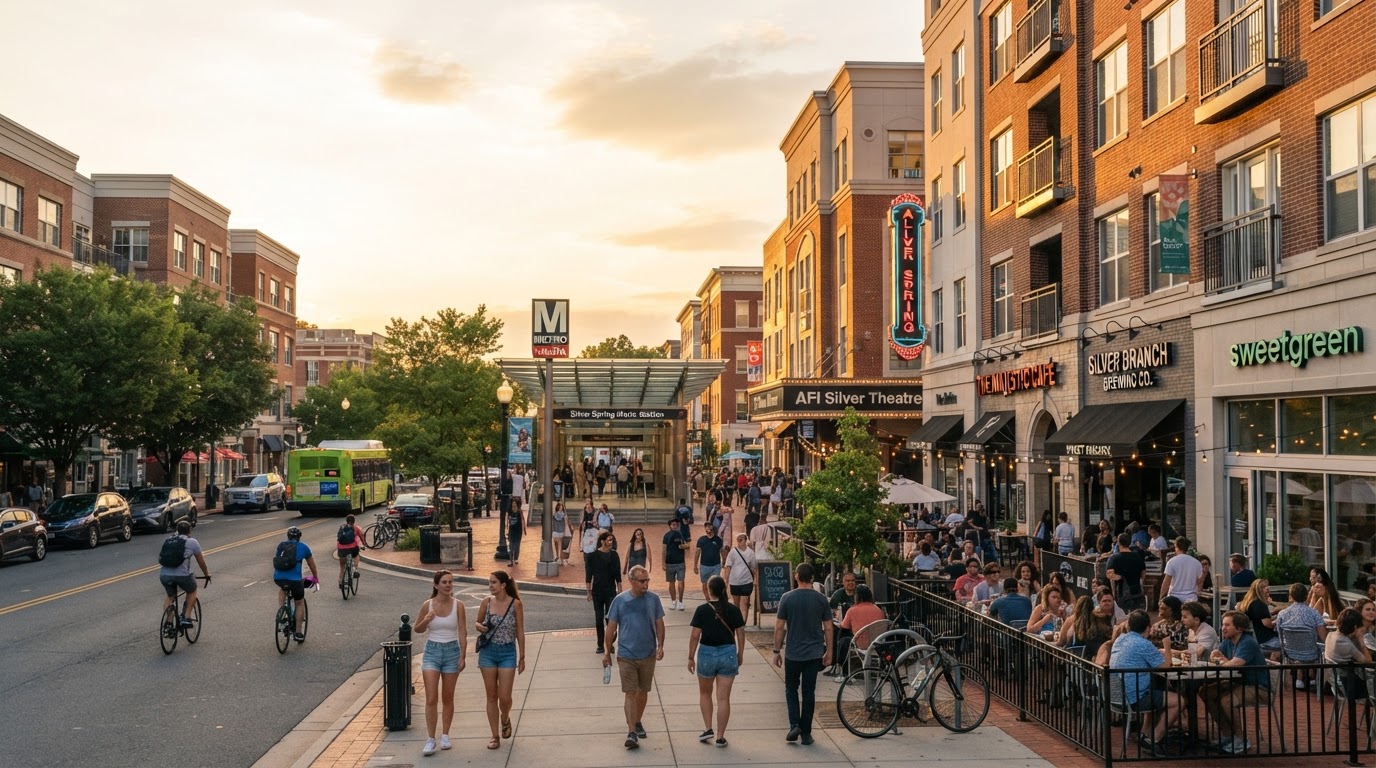
Downtown Silver Spring's walkable commercial core puts restaurants, retail, and Metro access within a few blocks of residential streets.
I have been watching downtown Silver Spring change for over 30 years. I still own rental property here. I watched what happened when Whole Foods came downtown. I watched the Fillmore open. I have watched neighborhoods that people used to overlook turn into some of the most competitive markets in the entire DC Metro Area.
Downtown Silver Spring is the urban core of a much larger community. It is anchored by the Silver Spring Metro station and it is the most walkable part of the market. Transit-oriented living, nightlife, restaurants, live music, and independent film are all part of the draw. The housing is a mix of condos, co-ops, older homes, and some newer infill homes. If you want the full picture of how Silver Spring's three corridors compare, start with the complete Silver Spring community guide I put together. This post goes deep on the downtown core specifically.
Walkability scores are useful. They confirm what you already suspect. But a number on a screen does not tell you whether this lifestyle actually fits your daily routine, what it costs to buy into it, or what you give up in exchange. Let me walk you through what the scores don't capture.
What Walkability Actually Means Here
Downtown Silver Spring has a Walk Score of 90 or higher. That number means most daily errands can be accomplished on foot. In practice, what that looks like is a neighborhood where you can walk to a grocery store, walk to dinner, walk to a movie, walk to the Metro, and walk to a concert without needing to get in a car or plan a transit route. The commercial density along Ellsworth Drive and the surrounding blocks makes that real, not theoretical.
What the score does not tell you is how that density shapes your daily rhythm. When you live downtown, your evening options expand. You can grab dinner at a restaurant you walked past that morning. You can catch a film at the AFI Silver Theatre without parking. You can meet friends without coordinating who drives. For people coming from a car-dependent suburb, that shift is genuinely lifestyle-changing. It is not a minor convenience. It changes how you think about your evenings and weekends.
The tradeoff is that downtown living means density. You have neighbors above, below, and beside you. Street noise is part of the package. If you are coming from a single-family home on a quiet cul-de-sac, that transition takes adjustment. Some people love it. Others realize after six months that they miss the quiet. Knowing which kind of person you are before you buy is the point of this post.
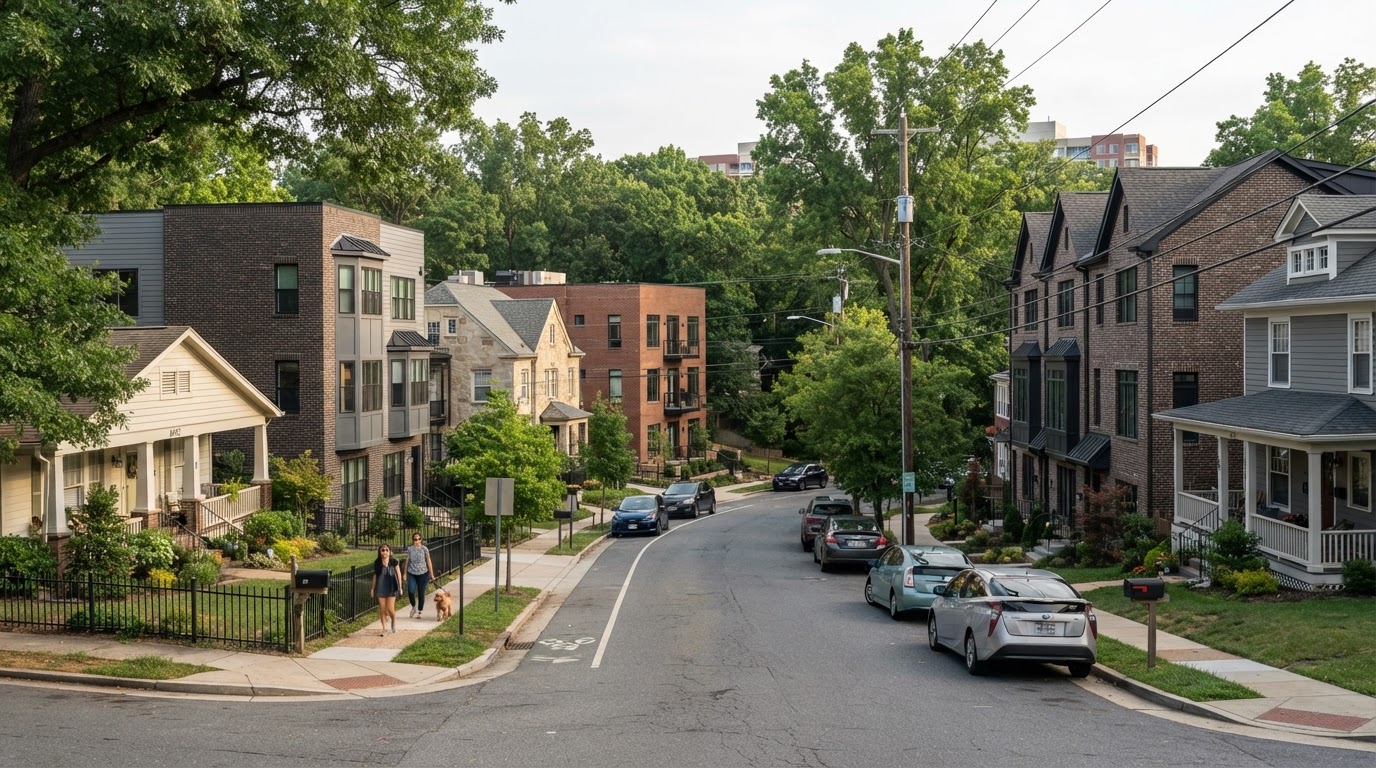
Downtown Silver Spring's housing stock ranges from older buildings with character to newer infill construction that blends into the walkable grid.
What It Costs to Live Downtown
Condos and co-ops in downtown Silver Spring typically sell in the low-$200s to mid-$500s, with a recent sold median around $310,000, depending on size, building, and floor. HOA fees in downtown Silver Spring vary by building, not simply by age. Some newer buildings carry full amenity packages that push monthly costs higher. Some older buildings carry higher fees too, often because utilities are included or because maintaining an older building costs more. Either way, factor the HOA fee into your total housing budget, not just the purchase price.
Fee simple houses, attached and detached, are a much smaller slice of downtown's housing stock, and they sell in a different price tier entirely. Recent sales have run from roughly $490,000 to $1.5 million, with a sold median around $850,000. That range also reflects a handful of blocks bordering DC that fall within downtown's walkable radius, which pulls the top end higher than a typical Maryland-only comparison. If a yard and a house are non-negotiable for your downtown search, expect to be shopping in that higher tier.
Walkability and Metro access are priced in. You are paying for the convenience of not needing a car for most of your daily life. That premium is real and it is reflected in the per-square-foot cost compared to neighborhoods further from the Metro. The question is whether that premium is worth it for your situation, and that depends on how much you actually use the walkability.
If you work downtown or along the Red Line, the math often works. You save on a second car, on parking, and on the time a longer commute would cost. If you work from home and rarely use transit, you are paying for access you may not fully use. I walk buyers through this calculation honestly before we start touring, because the answer changes which neighborhoods should even be on your list. If you want a personalized, market-based valuation of what your current home is worth as you plan a move, that is a separate conversation I can help with.
The Transit Picture Beyond the Score
The Red Line serves the entire Georgia Avenue corridor from Silver Spring through Forest Glen, Wheaton, and Glenmont. From the Silver Spring station, you are roughly 25 to 30 minutes to Metro Center under normal conditions. That is a real, repeatable commute number, not a best-case scenario. The MARC Brunswick Line also stops at Silver Spring, connecting commuters directly to Union Station in DC and points west into Maryland.
The Purple Line, still under construction, will run east-west and complement the Red Line, which runs mostly north-south. When complete, it will open up new connections from Bethesda to University of Maryland that currently require driving or bus transfers. For buyers thinking about long-term value, that added connectivity is worth understanding, though development timelines are long and I would not recommend buying solely on the basis of a project that has not yet opened.
For now, the bus network fills the gaps. Ride On and Metrobus routes serve the broader area, including the Route 29 corridor, which does not have Metro access but has reasonable bus coverage. The practical reality is that downtown Silver Spring residents who work along a transit line can live comfortably with one car or no car. Households who need to commute in multiple directions or whose work is not transit-accessible will still rely on driving, and traffic on Georgia Avenue, University Boulevard, and the Beltway is part of daily life during peak hours.
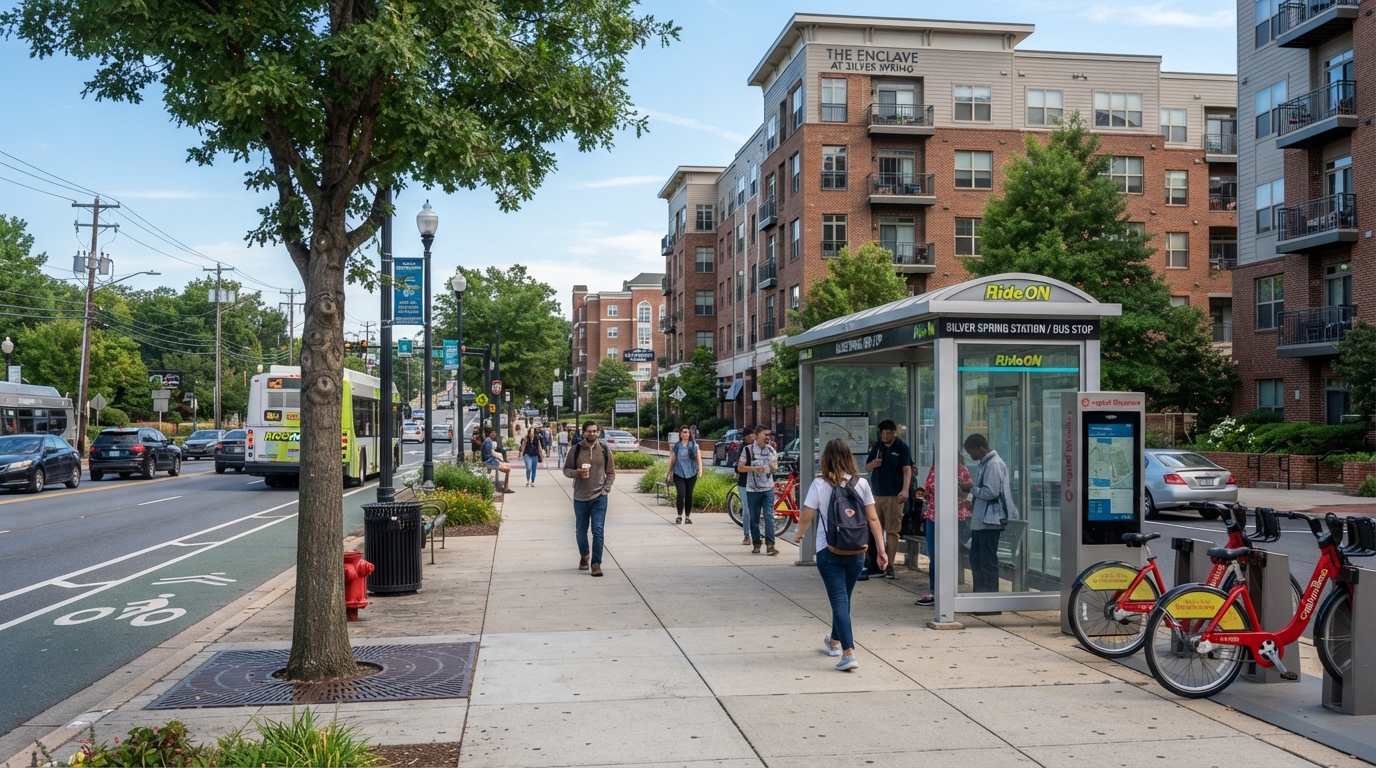
Bus connections and bike infrastructure extend downtown Silver Spring's transit reach beyond the Red Line for residents who go car-free or car-light.
What the Score Misses
Walkability scores measure proximity to amenities. They do not measure the quality of those amenities, the character of the streetscape, or how safe and comfortable it feels to walk somewhere at 9 p.m. in November. Downtown Silver Spring scores well because the density is there. Whether that density translates into a neighborhood you actually enjoy living in depends on factors the score cannot capture.
The dining scene here is genuinely deep. The diversity of the community shows up in the food in a way that is worth experiencing firsthand. There are restaurants I have been going to for years that still surprise me. There is live music at the Fillmore, classic and independent film at the AFI Silver Theatre, and a street scene around Veterans Plaza that runs year-round with concerts, outdoor movies, and seasonal markets. These are not bullet points on a score. They are the texture of daily life, and they matter more than a number when you are deciding where to live.
The score also does not tell you about the Sligo Creek Trail, which runs through the heart of the community and connects to the Northwest Branch Trail. That is a genuine car-free corridor for cyclists and runners, and it is one of the quality-of-life assets that downtown residents use constantly but that does not show up in a walkability metric. If you are exploring buying a home in this area, the trail system is worth factoring into your decision.
Who Downtown Silver Spring Is Right For
Downtown Silver Spring works best for people who want urban convenience without paying DC prices. If you value walking to dinner, transit access for your commute, and a neighborhood with a genuine street life, this is one of the few places in the DC Metro Area where you get that at a price point that remains accessible. Condos starting in the mid-$200s are a realistic entry point for buyers who would be priced out of comparable walkability in DC or Bethesda.
It is less ideal for buyers who need a single-family home with a yard, a quiet street, and distance from commercial activity. Those buyers should look at the Route 29 corridor neighborhoods like Four Corners or the Georgia Avenue corridor neighborhoods further north. The tradeoff is clear: more space and quiet for less walkability and a longer commute.
I always tell buyers to know their corridor before they start touring. Downtown is one version of Silver Spring. It is not the only one. The buyers who struggle are the ones who come in without a plan and try to compare a downtown condo against a single-family home in Four Corners without understanding that those are fundamentally different lifestyles, not just different price points.
A Realtor's Take
I have been a landlord here for years. I have watched downtown Silver Spring go from a place people drove past on their way somewhere else to one of the most sought-after walkable neighborhoods in the DC Metro Area. That transition is real, and the demand is not going away.
The thing I tell every buyer considering downtown is this: the walkability score is a starting point, not a conclusion. Spend a week here before you buy. Walk to the grocery store at 6 p.m. on a Tuesday. Take the Metro to work on a Monday morning. Sit on a bench at Veterans Plaza on a Saturday and watch the neighborhood move. If that rhythm feels like home, you will love it here. If it feels like too much, there are quieter corridors in Silver Spring that still give you transit access without the density. My job is to help you figure out which one fits before you spend money on the wrong one.
Harry Moore, REALTOR® | A.I. Certified Agent™ | Harry Moore HOME | eXp Realty | DC SP98376 · VA 0225037887 · MD 505462
Frequently Asked Questions
What is the Walk Score for downtown Silver Spring?
Downtown Silver Spring has a Walk Score of 90 or higher, making it one of the most walkable neighborhoods in the DC Metro Area outside of DC itself. That score reflects the density of restaurants, retail, and transit within a short walking radius of the Silver Spring Metro station.
How much do condos cost in downtown Silver Spring?
Condos and co-ops in downtown Silver Spring typically sell in the low-$200s to mid-$500s, with a recent sold median around $310,000, depending on size, building, and floor. HOA fees in downtown Silver Spring vary by building, not simply by age. Some newer buildings carry full amenity packages that push monthly costs higher. Some older buildings carry higher fees too, often because utilities are included or because maintaining an older building costs more. Either way, factor the HOA fee into your total housing budget, not just the purchase price. Walkability and Metro access are priced into these values.
How long is the commute from Silver Spring to DC?
From the Silver Spring Metro station on the Red Line, the ride to Metro Center in downtown DC takes approximately 25 to 30 minutes under normal conditions. The MARC Brunswick Line also stops at Silver Spring, providing a direct rail connection to Union Station.
Is downtown Silver Spring a good place to live without a car?
Many residents live in downtown Silver Spring without a car or with one car per household instead of two. The combination of Metro access, walkable grocery and dining, bus connections, and bike infrastructure makes car-free or car-light living practical for people whose work is transit-accessible. The tradeoff is that exploring other parts of the DC Metro Area still requires transit planning or a rideshare.
What is the difference between living in downtown Silver Spring and the surrounding neighborhoods?
Downtown Silver Spring offers transit-oriented urban living with condos, co-ops, and walkable access to restaurants, retail, and entertainment. Surrounding neighborhoods like Four Corners, Forest Glen, and Wheaton offer more single-family housing, larger lots, and quieter residential streets, generally at different price points. The right choice depends on whether you prioritize walkability and transit access or space and a more suburban feel.

About Harry Moore
Realtor, A.I. Certified Agent™ | eXp Realty LLC
Harry Moore is a licensed real estate agent and A.I. Certified Agent™ with eXp Realty LLC, with 30+ years of experience helping buyers and sellers across the DC Metro Area navigate major life transitions with confidence.
Ready to Explore Downtown Silver Spring?
I can walk you through what is currently on the market, what it is actually worth, and whether downtown Silver Spring fits your lifestyle before you spend time touring the wrong homes. Call me at 202-362-4663 or schedule a no-pressure 15-minute call.